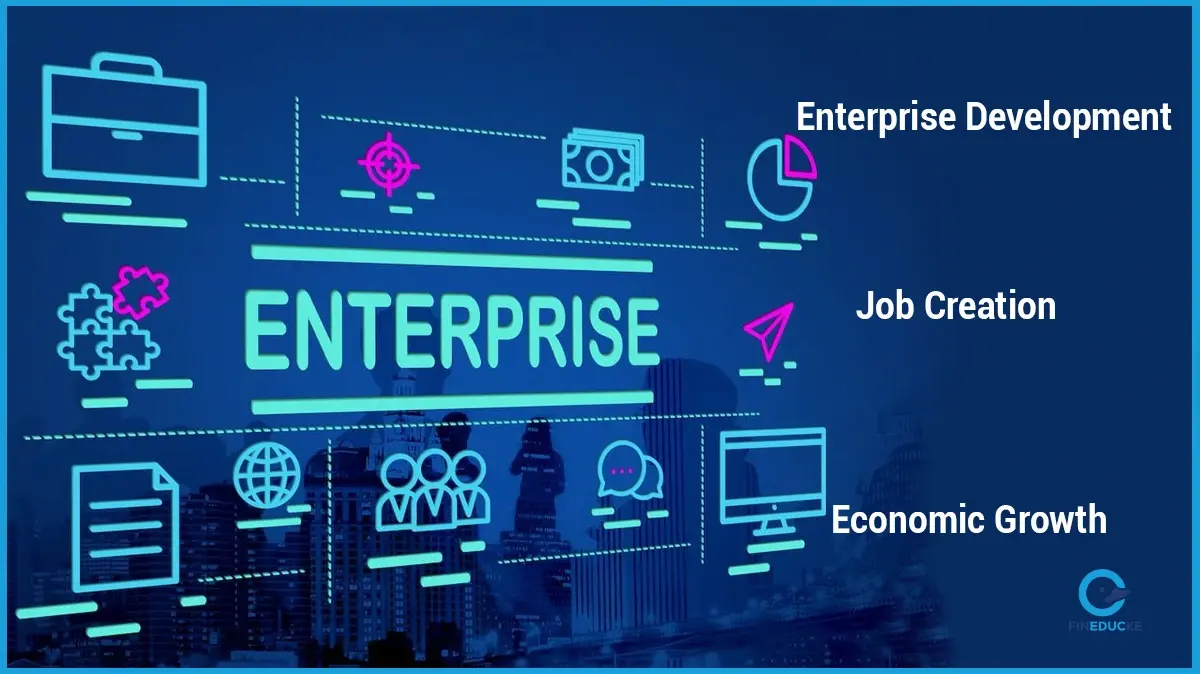
Enterprises are an essential part of every economy. They create employment opportunities, encourage innovation, and contribute to the production of goods and services that improve living standards.
The growth and development of enterprises, particularly small and medium-sized enterprises (SMEs), have proven to be of great significance to many economies around the world.
This growth is also evident in how entrepreneurship is evolving in modern economies, as seen in emerging trends in entrepreneurship, where new business models, digital tools, and innovative approaches are reshaping how businesses operate and grow..
Through the rise of these enterprises, many people, especially in developing nations, have experienced reduced poverty levels, improved efficiency in the use of resources, and overall increased economic activity.
As a result, enterprise development has become an effective tool for governments seeking to stimulate economic growth and create sustainable job opportunities.
What is an enterprise?
An enterprise is a well-organized business set up that is made up of a manager along with a team who work together to achieve specific business goals.
Apart from profit, enterprises often seek to improve the economic environment within the societies in which they operate. A successful enterprise requires a lot of effort and boldness especially during the initial set up. It has to convince all the stake holders involved that it is a project that is viable and will bring rewards
Difference Between a Business and an Enterprise
The terms business and enterprise are often used interchangeably because both involve providing goods or services to customers with the aim of profit making.
However, in the context of financial education, these two differ: Usually, an enterprise refers to a more organized and growth-oriented venture. While a business can be any commercial activity.
The main differentiator is that an enterprise places greater emphasis on innovation, long-term development, job creation, and creating value for the wider economy.
On the other hand, a business can just be a simple set up where one runs it to just generate enough income for their household without the vision of expanding.
In simple terms, every enterprise is a business, but not every business evolves into an enterprise. For example, a person running a small neighborhood bakery operates a business, whereas a company with structured operations, employees, and expansion plans such as Amazon can be regarded as an enterprise.
Importance of enterprise development
Enterprise Development and job creation go hand in hand. They are programs that are dedicated to unlocking the enormous potential of enterprises to create decent, long-lasting jobs.
Decent work can only exist in competitive, productive, and economically viable firms. A good development program in any economy seeks to enhance the positive interaction that exists between the improved competencies of managers, basic workers' rights and productivity.
Small and medium sized enterprises and cooperatives are major contributors to job creation. An increase in their number can provide decent employment to the many people around the world now toiling under poor working conditions and trapped in poverty. This idea is further supported by the fact that most small business enterprises are labor-intensive and could use the large numbers of available cheap labor.
Young people after graduating from universities and colleges need an avenue to demonstrate their knowledge and skills in a productive manner. This requires that the environment for this is conducive for them to set up.
The government should play a role in ensuring a stable political, social and economic environment that will ensure the smooth start of the enterprises. In addition, funds should be availed for viable projects that have passed through the relevant testing by experts before the proposals are presented for deliberation. This acts to ensure that resources are optimally utilized.
On their side, prospective entrepreneurs need to be creative and innovative enough to put on paper ideas that have a business angle, ideas that do not just lead to their own self-fulfillment but also puts the needs of the society they serve into account.
Small enterprises tend to be more effective in the utilization of local resources using simple and affordable technology. Small enterprises play a fundamental role in utilizing and adding value to local resources. In addition, development of small enterprises facilitates distribution of economic activities within the economy and thus fosters equitable income distribution.
Also read: Difference between Startup and Small Business
Furthermore, small enterprises technologies are easier to acquire transfer and adopt. Also, small enterprises are better positioned to satisfy limited demands brought about by small and localized markets due to their lower overheads and fixed costs.
Moreover, the owners tend to show greater resilience in the face of recessions by holding on to their businesses, as they are prepared to temporarily accept lower compensation.
Through business networks, partnerships and subcontracting relationships, small enterprises have great potential to complement large industries requirements.
A strong and productive industrial structure can only be achieved where small enterprises and large enterprises not only coexist but also function in a symbiotic relationship.