Real estate has created more millionaires than almost any other asset class, yet most beginners never buy a single property because the process feels too complicated to start. That confusion is the actual barrier, not the money.
If you look at the top 10 richest people in the world, you'll notice an interesting pattern. They built their fortunes through businesses, technology, luxury goods, and investing, but every one of them owns real estate as part of their wealth.
None of them ignores the asset class. For a long time, real estate has become a core part of growing and preserving wealth.
This guide is built for the beginner investor, someone who has the desire not only to become rich, but also to become wealthy.
With the right financial literacy, real estate can become a powerful asset for generating income, building equity, and moving you closer to your FIRE Number.
By the end of this guide, you'll understand:
- What real estate entails
- How to generate income and build wealth through real estate
- How to choose an investment strategy that fits your budget, time, and goals
- How to analyze a deal and avoid the mistakes that cost beginner real estate investors
- How real estate compares to stocks, bonds, gold, and other places you could put your capital, just like how the once percent invest their money.
What Is Real Estate?
Real estate is land and anything permanently attached to it: buildings, structures, and natural resources like trees or minerals. Every piece of real estate has two elements. The land itself, and the improvements built on it, such as a house, a warehouse, or a paved parking lot.
There are two terms that often confuse many people: Real estate and real property. They might seem like synonyms but they differ slightly.
Real estate refers to the physical asset itself: the dirt and everything fixed to it. Real property is a broader legal concept. It includes the physical asset plus the bundle of rights that come with owning it, such as the right to sell, lease, mortgage, or build on the land.
When you buy real estate, you're acquiring the real property, meaning you get ownership to the physical land/structure and the legal rights attached to it.
This distinction matters because it explains why real estate functions as an investment asset in the first place.
A stock is a claim on a company's future profits. A bond is a claim on repayment of a loan. Real estate is different: it's a physical, tangible asset that generates value in multiple ways at once.
It can produce income through rent, gain value through appreciation, and give the owner direct control over decisions that affect its performance, such as renovations, tenant selection, or how the property is financed.
Stocks and bonds offer none of that control. You buy shares in a company and hope management makes good decisions. You buy real estate and you are the management.
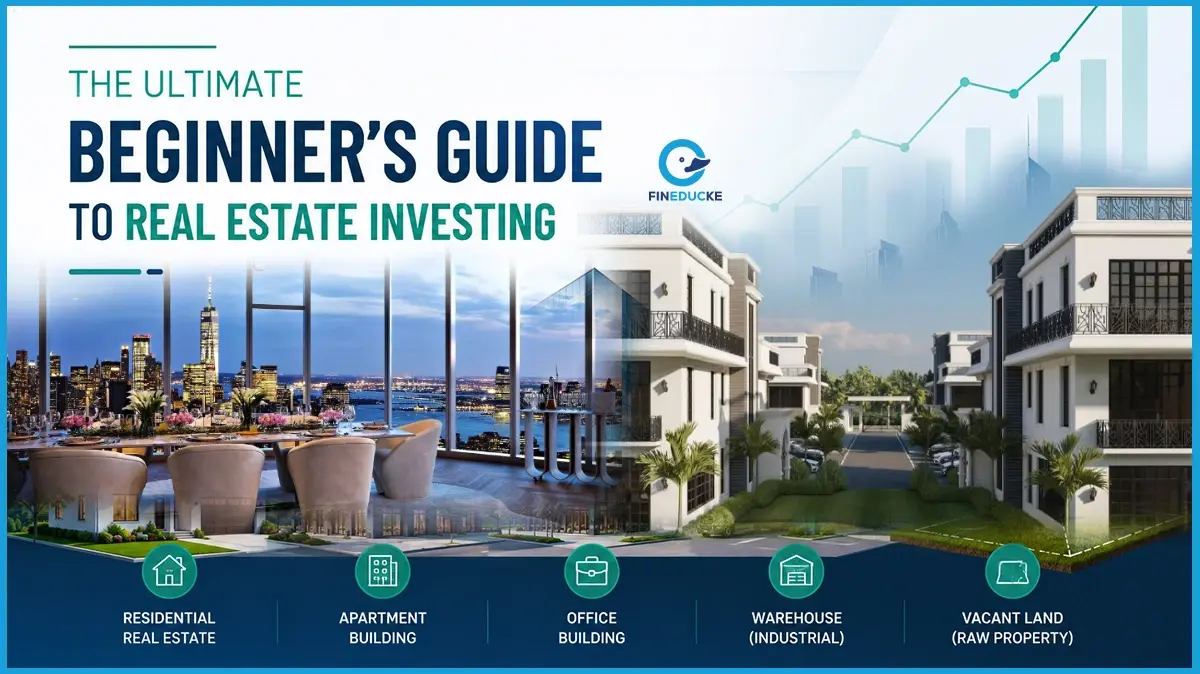
Real estate is generally divided into five property types, and understanding them is the foundation for everything that follows in this guide.
5 five property types in real estate
Residential. Properties used for housing: single-family homes, condos, multi-family units, and apartment buildings.
Commercial. Properties used for business activity: office buildings, retail spaces, hotels, and shopping centers.
Industrial. Properties used for manufacturing, production, storage, and distribution: warehouses, factories, and logistics centers.
Land and raw property. Undeveloped or unimproved land, including agricultural land and land held for future development.
Special purpose. Properties built for a specific use that doesn't fit the other four categories: schools, places of worship, self-storage facilities, and government buildings.
Each type carries a different risk profile, capital requirement, and income potential, which is why choosing where to invest starts with understanding what you're actually choosing between.
Why Invest in Real Estate?
Once you understand what real estate is, the next question is why it consistently attracts capital that could go anywhere else. Six reasons stand out.
Cash flow and passive income
A rental property generates monthly income from tenants. After covering the mortgage, taxes, and expenses, whatever is left is cash flow, money that lands in your account whether or not you actively worked that month.
Long-term appreciation
Real estate tends to gain value over time, driven by population growth, economic development, and limited land supply. Appreciation is never guaranteed year to year, but held over a long enough horizon, property values have historically trended upward across most markets.
Portfolio diversification
Real estate doesn't move in lockstep with stocks and bonds. Adding it to a portfolio spreads risk across an asset class with its own separate set of drivers, so a downturn in equities doesn't automatically mean a downturn in your property holdings.
Inflation hedge
As the cost of living rises, so do property values and rents. Real estate has a track record of keeping pace with inflation better than cash or fixed-income assets, which lose purchasing power when prices climb.
Leverage
Real estate is one of the few assets where you can control a large, appreciating asset using a small amount of your own money and borrowed capital. A 20% down payment gives you 100% of the property's income and appreciation potential.
Tax advantages
Real estate investors have access to deductions and strategies that reduce taxable income significantly, covered in full in Section 8.
Together, these six factors are why real estate remains a core building block of long-term wealth, not just a place to live.
The Wealth Generators: Ways to Make Money in Real Estate
Real estate doesn't make money one way. It makes money through several distinct mechanisms, and understanding each one helps you see which strategies fit your goals later in this guide.
Rental income
The most straightforward wealth generator. You buy a property, rent it to a tenant, and collect monthly payments. After expenses, the surplus is profit that repeats every month the property stays occupied. This is the backbone of long-term, buy-and-hold investing.
Property appreciation
Beyond monthly income, real estate builds wealth simply by increasing in value over time. A property bought for $200,000 that appreciates to $280,000 over ten years has generated $80,000 in equity without the owner doing anything beyond holding it. Appreciation is the slow, compounding engine behind most long-term real estate fortunes.
Equity build-up through amortization
Every mortgage payment is split between interest and principal. The principal portion pays down your loan balance, which means your tenant's rent is gradually converting into ownership. Over years, this steadily shrinks what you owe and grows what you actually own, even if the property's value never moves.
House flipping
Buying a property below market value, renovating it, and reselling it quickly for a profit. Flipping generates money through forced appreciation: you increase the property's value through improvements rather than waiting for the market to do it. It's faster than buy-and-hold, but it carries higher risk and requires accurate cost estimation.
Wholesaling
Contracting a property at a low price, then selling that contract to another buyer for a fee before ever taking ownership. Wholesalers make money on the spread between the contract price and what a buyer is willing to pay, without needing capital to purchase the property themselves.
REIT dividends
Real Estate Investment Trusts pool investor money to buy and manage income-producing properties. By law, REITs must distribute the majority of their taxable income to shareholders as dividends. This lets investors earn real estate income without owning or managing physical property.
Short-term rentals
Renting a property by the night or week, typically through platforms built for short stays, instead of to a long-term tenant. Nightly rates are usually higher than monthly rent divided by 30, which can produce stronger cash flow, though it comes with higher turnover and more active management.
Commercial leasing
Leasing space to businesses instead of individuals. Commercial leases tend to run longer than residential ones and often shift some property expenses onto the tenant, which can mean more predictable, stable income for the owner.
Each of these methods can stand alone or work together, and the strategy you build around them is what the next section covers.
Real Estate Investment Strategies
Before you make the decision on how to invest in real estate, it is important to learn the available and proven strategies. Knowing how real estate makes money is one thing. Deciding how you want to make it is another. Every approach falls into one of two categories: active, where you're directly involved in managing the investment, or passive, where your capital works without your daily involvement.
Active strategies
Buy-and-hold rentals
Purchase a property, rent it out, and hold it for years while collecting rental income and building equity through appreciation and amortization.
This is the most common entry point for new investors.
House flipping
Buy underpriced or distressed properties, renovate them, and resell for a profit. Requires accurate budgeting, contractor management, and a good read on local resale values.
Wholesaling
Contract properties at a discount and assign that contract to another buyer for a fee. Low capital requirement, but success depends on deal-sourcing skill and a network of buyers.
Short-term rentals
Manage a property for nightly or weekly stays. Higher income potential than long-term renting, but demands active involvement in bookings, cleaning, and guest turnover.
BRRRR
Buy, Rehab, Rent, Refinance, Repeat. Purchase a distressed property, renovate it, rent it out, then refinance to pull your original capital back out and use it on the next deal.
Built for investors who want to scale without constantly injecting new cash.
Property development
Buy raw land or existing structures and build new or significantly redevelop what's there.
Highest potential return, highest capital requirement and risk, and usually not a beginner's starting point.
Commercial investing
Purchase or lease office, retail, or industrial property to businesses. Longer leases and larger deal sizes than residential, with correspondingly higher capital and expertise requirements.
Passive strategies
REITs
Real Estate Investment Trusts (REITs) are regulated investment vehicles that pool capital to invest in, manage, or finance income-producing real estate. If you want to invest in real estate online, then REITs is one of the best method. Here, you buy shares in a company that owns and manages income-producing real estate. Trade like stocks, offer liquidity, and pay dividends without any property management on your part.
Crowdfunding
Pool money with other investors, through an online platform, into a specific property or portfolio. Lower minimum investment than buying property directly, with returns tied to the platform's performance.
Real estate funds and LPs
Invest in a professionally managed fund or limited partnership that holds multiple properties. You provide capital, the fund manager handles acquisitions and operations.
Syndications
A group of investors pools money to buy a single large property, led by a sponsor who manages the deal. Common for apartment complexes and larger commercial assets.
Turnkey rental investing
Buy a property that's already renovated and tenanted, often managed by the seller's own property management arm. Minimal hands-on work required after purchase.
How to choose
The right strategy depends on five factors: how much capital you have, how much time you can commit, how much risk you can tolerate, what you're actually trying to achieve, and what markets you can realistically access. A high-budget, low-time investor leans passive. A low-budget, high-time investor leans active. There's no universally correct strategy, only the one that matches your actual constraints.
How to Start Investing in Real Estate
Choosing a strategy is only step one. Turning that choice into an actual property requires a process, and skipping steps is where most beginners get into trouble. Here's the roadmap.
1. Define your goal
Start with what you actually want real estate to do for you. Monthly cash flow, long-term appreciation, a faster path to net worth through flipping, or a passive addition to an existing portfolio. Your goal shapes every decision that follows, so get specific before you get moving.
2. Assess your financial situation
Look honestly at your budget, your credit score, and whether you have an emergency fund separate from your investment capital. Real estate ties up money for years, sometimes decades, and lenders will scrutinize your credit and income before approving financing. Know your numbers before you start looking at properties.
3. Choose your strategy
Revisit Section 4 and pick the active or passive strategy that matches your budget, time, risk tolerance, and goal. This decision determines everything from the type of property you look for to the team you need to build.
4. Research and pick a target market
Not every location supports every strategy. Look at population growth, job market strength, rental demand, and price trends in the areas you're considering. A market that works for buy-and-hold rentals may not work for flipping, and a market with strong appreciation may have weak cash flow.
5. Build your team
Real estate is not a solo sport. You'll need a real estate agent, a lender, an attorney, an accountant, a property inspector, a contractor if you're renovating, and a property manager if you're not self-managing. Assembling this team before you need it, rather than scrambling once you're under contract, saves time and costly mistakes.
6. Secure financing
Get pre-approved or line up your capital before you start seriously shopping for properties. Section 7 covers the full range of financing options, from conventional mortgages to private lenders, so you know which fits your situation.
7. Analyze your first deal
Before making an offer, run the numbers. Section 6 walks through cash flow, cap rate, ROI, and the other metrics that separate a good deal from a bad one. Never skip this step because a property "feels right."
8. Make an offer / buy your first property
Once a deal checks out, submit your offer, complete due diligence, and close. This is the step everything before it was preparing you for.
9. Manage and grow your investment
Ownership is the start, not the finish. Manage the property well, track its performance, and use what you learn to evaluate your next deal. Most successful investors don't stop at one property. They repeat this roadmap, refining it each time.
How to Analyze a Real Estate Deal
This is the step that separates investors who build wealth from those who lose money on their first deal. Analysis happens on two levels: the market you're buying into, and the specific property itself.
Choosing a target market
Before evaluating any single property, evaluate the area it sits in. Population growth signals rising housing demand. Employment strength, particularly job diversity across multiple industries rather than dependence on one employer, indicates economic stability. Infrastructure investment, new transit lines, roads, and commercial development, tends to precede price growth.
School quality affects both rental demand and resale value, even for investors without children of their own. Crime rates influence tenant demand and insurance costs.
Rental demand itself, measured by vacancy rates and how fast listings get absorbed, tells you whether tenants are actually available. And the broader local economy, its growth trajectory and diversification, determines whether today's numbers hold up five years from now.
Analyzing the property
Once the market checks out, the property has to earn its price on paper. Cash flow is what's left after collecting rent and paying all expenses, including the mortgage.
Rental yield measures annual rental income as a percentage of the property's price. Cap rate divides net operating income by the property's value, giving you a way to compare properties independent of financing.
ROI measures total return relative to total investment. Cash-on-cash return narrows that further, measuring annual cash flow against the actual cash you put in, which matters more once leverage is involved.
GRM, the gross rent multiplier, divides price by annual gross rent for a fast, rough comparison across listings. The 1% rule is a quick screening test: monthly rent should be at least 1% of the purchase price for a deal to be worth deeper analysis.
NOI, net operating income, is income after operating expenses but before debt payments. Operating expenses themselves, taxes, insurance, maintenance, and property management, need to be estimated accurately, not guessed, because they determine your real estate profit margins. And appreciation potential, based on the market factors above, tells you whether the property's value is likely to grow over your holding period.
Due diligence
Numbers can look right and still hide a bad deal. A property inspection uncovers structural, electrical, plumbing, or roofing issues before they become your problem.
A title search confirms the seller actually owns the property free of liens or disputes. Zoning review confirms the property can legally be used the way you intend, especially important for short-term rentals or any change of use.
And an environmental check flags contamination, flood risk, or other liabilities that don't show up in a listing photo.
Skip any one of these three layers, market, numbers, or due diligence, and you're not investing. You're gambling with extra steps.
Financing Real Estate Investments
A deal that checks out on paper still needs capital behind it. How you finance a property shapes your returns, your risk, and how fast you can scale, so it's worth understanding the full range of options before defaulting to the first one you hear about.
Buying with cash
No mortgage, no lender, no monthly debt payment. Cash buyers close faster and have more negotiating leverage, especially on distressed properties. The tradeoff is that all your capital sits in one deal, and you lose the amplifying effect leverage provides on returns.
Conventional mortgages
A loan from a bank or private lender, typically requiring a down payment between 15% and 25% for investment properties. This is the standard financing route for buy-and-hold investors with solid credit and steady income.
FHA and VA loans
Government-backed loans with lower down payment requirements, generally reserved for owner-occupied properties. Investors sometimes use them for house hacking, buying a small multi-family property, living in one unit, and renting out the rest.
Hard money loans
Short-term loans from private lenders, secured by the property itself rather than the borrower's credit profile. Interest rates run higher than conventional loans, but approval is fast, making hard money common for flips and time-sensitive deals.
Private money lenders
Individuals, rather than institutions, who lend their own capital in exchange for interest, often at terms negotiated directly between both parties. Relationship-based and more flexible than institutional lending, but it requires an actual network of people willing to lend.
Seller financing
The seller acts as the lender, and the buyer makes payments directly to them instead of a bank. Useful when a buyer doesn't qualify for traditional financing, or when a seller wants a steady income stream instead of a lump sum.
Partnerships
Two or more investors combine capital, credit, or expertise to fund a deal neither could, or would want to, do alone. Requires a clear agreement on roles, profit splits, and exit terms before money changes hands.
HELOC / home equity financing
Borrowing against the equity in a property you already own, typically your primary residence, to fund the purchase of another. Gives existing homeowners a way to invest without new outside financing.
Real estate crowdfunding
Pooling money with other investors through an online platform to fund a property or portfolio, without arranging financing yourself. Lower capital requirement, but less control over the deal's terms and management.
The right financing choice depends on your capital, your credit, your timeline, and the strategy you chose in Section 4. There is no single best option, only the one that fits the deal in front of you.
Legal and Tax Structures: Protecting Your Assets
Buying a property is only half the job. Structuring how you own it, and how you handle its tax obligations, determines how much of your return you actually keep and how exposed you are if something goes wrong.
Ownership structures
- Individual ownership. You hold the property in your own name. Simple and inexpensive, but it offers no liability protection. If something goes wrong on the property, your personal assets are exposed.
- LLC. A limited liability company separates the property's liabilities from your personal assets. If a tenant sues over an injury on the property, the LLC, not your personal bank account, is on the hook. This is the standard structure for investors holding rental property.
- Series LLC. A single LLC that holds multiple separate "series," each with its own assets and liabilities, isolated from the others. Useful for investors with multiple properties who want protection between them without forming a new LLC for every purchase.
- S-Corp. Primarily used for active real estate businesses, like flipping or wholesaling, rather than long-term rental holding, mainly for its tax treatment of active income.
- Partnerships. Two or more owners share the property, along with its income, expenses, and liabilities, according to a partnership agreement.
- Trusts. Hold property for estate planning purposes, controlling how it transfers to heirs and, depending on the trust type, offering privacy and probate avoidance.
Choosing the right structure depends on how many properties you own, your liability exposure, and your long-term plans, which is exactly why this decision shouldn't be made alone.
Tax advantages
Depreciation lets you deduct a portion of the property's value each year as a paper loss, even while it's appreciating in actual market value. The mortgage interest deduction reduces taxable income by the interest paid on your loan.
Operating expense deductions cover costs like repairs, insurance, and property management fees. A 1031 exchange lets you sell a property and reinvest the proceeds into another one, deferring capital gains tax entirely.
Qualified Opportunity Zones offer tax incentives for investing in designated, economically distressed areas, including deferred and potentially reduced capital gains.
Insurance and record keeping
Adequate property insurance protects against damage and liability claims. Accurate, organized records of income, expenses, and improvements make tax filing easier and protect you if you're ever audited.
None of this should be structured alone. A CPA and a real estate attorney should be part of this decision before you close on a property, not after.
Factors That Affect Real Estate Prices
Every deal you analyze in Section 6 depends on prices that are moving for reasons outside any single transaction. Understanding what actually drives those prices helps you read a market instead of just reacting to it.
Demand-side factors
Population growth increases the number of people who need housing, and more buyers competing for the same supply pushes prices up.
Employment, both the number of jobs and their quality, determines how many people can actually afford to buy or rent in an area. Interest rates directly affect what buyers can borrow: lower rates mean cheaper financing and more buying power, which drives prices up, while higher rates shrink what buyers can afford and cool demand.
School quality consistently commands a price premium, since it draws buyers regardless of whether they have children, simply because it protects resale value.
Supply-side factors
Construction pace determines how quickly new housing meets demand. When builders can't keep up, existing properties become more valuable. Land and zoning constraints limit how much new supply can be built in the first place.
Areas with strict zoning or limited developable land see slower supply growth, which tends to support higher prices. Foreclosure inventory adds supply quickly, and a wave of foreclosures can push prices down as distressed properties compete with regular listings.
Macro factors
Inflation raises construction costs and pushes investors toward tangible assets, both of which support higher prices. GDP growth reflects overall economic health, and stronger economies generally support stronger real estate markets.
Credit conditions, how easily banks are willing to lend, control how many buyers can actually access financing. Government policy, including tax incentives, zoning law, and housing programs, can accelerate or slow price growth depending on the direction it pushes.
Infrastructure development raises the value of surrounding property before and after it's completed. And neighborhood trends, gentrification, business growth, or decline, shift demand at a hyperlocal level, sometimes independent of the broader market.
No single factor moves prices alone. Markets shift when several of these forces line up in the same direction at once.
Advantages and Disadvantages of Real Estate Investing
Advantages
Real estate generates cash flow, monthly income that lands regardless of what the broader market is doing that day. It builds wealth through appreciation, gaining value over the years you hold it.
Leverage lets you control a large asset with a fraction of its value in cash, amplifying your returns on the capital you actually put in.
It adds diversification to a portfolio otherwise concentrated in stocks and bonds. It functions as an inflation hedge, since property values and rents tend to rise alongside the cost of living.
It comes with meaningful tax advantages, covered in full in Section 8. And unlike a stock certificate, it's a tangible, controllable asset: you can see it, improve it, and directly influence its performance.
Disadvantages
Real estate demands a high capital requirement, whether that's a down payment, closing costs, or reserves for repairs. It's illiquid: you can't sell a property in seconds the way you'd sell a stock.
It carries a real management burden, tenants, maintenance, and vacancies don't manage themselves. It's exposed to market fluctuations, and values can fall as easily as they rise.
And it carries regulatory and legal exposure, from zoning changes to landlord-tenant law that varies by jurisdiction and can shift with little warning.
Common risks
Beyond the structural disadvantages, every real estate investment comes with risks that can reduce your returns or even turn a profitable deal into a loss.
A market downturn can reduce property values, especially if you're forced to sell during a weak market. Even a good investment can lose value in the short term.
Vacancy periods mean no rental income while expenses like mortgage payments, insurance, and taxes continue. Unexpected repairs can also eat into your cash flow when you least expect them.
Bad tenants can create another layer of risk by missing rent payments or damaging the property, leading to costly repairs and legal disputes.
Financing can become more expensive if interest rates rise on a variable-rate loan or if refinancing becomes difficult.
Finally, regulatory changes, such as new rent control laws, zoning rules, or landlord-tenant regulations, can change the economics of a property long after you've bought it.
Real estate isn't inherently safer or riskier than any other asset. It carries a different shape of risk, one that rewards investors who understand it and punishes those who don't.
Common Beginner Mistakes
- Buying without research or emotional investing. Falling for a property because it "feels right" instead of running the numbers from Section 6. Emotion is a bad substitute for analysis, and it's the single most common way beginners overpay.
- Ignoring cash flow. Chasing appreciation potential alone while ignoring whether a property actually supports itself month to month. A property that bleeds cash every month can bankrupt an investor before appreciation ever pays off.
- Underestimating expenses. Forgetting maintenance, vacancy, capital expenditures, or property management fees when budgeting. Real numbers are always higher than the optimistic estimate.
- Poor financing decisions. Choosing financing based on what's easiest to get approved for, rather than what actually fits the deal and the strategy, as covered in Section 7.
- Skipping inspections or due diligence. Waiving an inspection to make an offer more competitive, or skipping the title search and zoning check from Section 6. What you don't find before closing becomes your problem after.
- Choosing the wrong market. Buying in a familiar or convenient location instead of one that actually meets the criteria from Section 6, like job growth, rental demand, and population trends.
- No emergency fund. Investing every available dollar into a property, leaving nothing for the first major repair or vacancy. Section 5 flagged this at step 2 for a reason.
- Poor tenant screening. Filling a vacancy quickly instead of carefully, and ending up with a tenant who damages the property or stops paying rent.
- No exit strategy. Buying a property without a plan for how or when to sell, refinance, or otherwise exit the investment.
- Self-managing without time, systems, or local knowledge. Trying to handle property management personally without the time, tools, or local market knowledge it actually requires.
- Skipping legal structure. Holding property in your own name instead of an LLC or other protective structure from Section 8, leaving personal assets exposed to a single lawsuit.
- Lack of diversification. Putting all available capital into one property, one market, or one strategy, instead of building a portfolio that spreads risk over time.
Every one of these is avoidable. None of them are new information by the time you reach this point in the guide, which is exactly the point.
Real Estate vs. Other Investments
Real Estate vs. Stocks/ETFs
|
Factor |
Real Estate |
Stocks/ETFs |
|
Liquidity |
Low - can take weeks or months to sell |
High - can sell in seconds during market hours |
|
Returns |
Steady, long-term, amplified by leverage |
Historically strong, but volatile year to year |
|
Income |
Rental income, paid monthly |
Dividends, paid quarterly or not at all |
|
Control |
Direct control over the asset and its performance |
No control over company decisions |
|
Tax treatment |
Depreciation, deductions, 1031 exchanges |
Capital gains tax, dividend tax |
|
Correlation |
Low correlation to public markets |
Tied to broader market sentiment and economic cycles |
Real Estate vs. Bonds
Bonds offer fixed, predictable income and high liquidity, with far less effort than owning property. But their returns are capped, and inflation erodes the value of those fixed payments over time. Real estate income can grow with inflation, and the underlying asset can appreciate, something a bond's face value never does.
Real Estate vs. Gold and Precious Metals
Gold holds value and acts as a hedge in times of economic uncertainty, but it generates no income and no cash flow. It just sits there. Real estate does everything gold does as a store of value, while also producing rental income and offering leverage, something a bar of gold can't provide.
Real Estate vs. Cryptocurrency
Cryptocurrency offers high liquidity and the potential for explosive returns, but it comes with extreme volatility and no underlying cash flow. Real estate moves slower, but it's backed by a physical asset with intrinsic utility, people need somewhere to live and work, regardless of what a token is trading at.
Real Estate vs. Savings Accounts
A savings account is safe and fully liquid, but interest rates rarely keep pace with inflation, meaning the real value of that money quietly shrinks over time.
Real estate carries more risk and far less liquidity, but it offers a realistic path to actually growing wealth instead of just preserving it.
The Verdict
Real estate isn't better or worse than any of these assets. It's different: less liquid, more hands-on, but capable of generating income, appreciation, and leverage in a way no other asset class combines.
The right allocation between real estate and everything else depends on your goals, your time horizon, and how much risk you're willing to carry. For most investors, the answer isn't real estate instead of stocks or bonds. It's real estate alongside them.
Key Real Estate Terms
- Appreciation. The increase in a property's value over time.
- Depreciation. A tax deduction that allows investors to write off a portion of a property's value each year, even as it appreciates in the market.
- Equity. The portion of a property you actually own, calculated as its current value minus what you still owe on it.
- Mortgage. A loan used to purchase property, secured by the property itself.
- Down payment. The upfront cash paid toward a property's purchase price, with the remainder financed through a mortgage.
- Closing costs. Fees and expenses paid at the completion of a real estate transaction, including title insurance, appraisal, and lender fees.
- Cash flow. The money left over after collecting rental income and paying all expenses, including the mortgage.
- Cap rate. Net operating income divided by property value, used to compare properties independent of financing.
- Cash-on-cash return. Annual cash flow divided by the actual cash invested, measuring return on the money you put in rather than the property's total value.
- ROI. Return on investment: total profit divided by total cost.
- GRM. Gross rent multiplier: a property's price divided by its annual gross rental income, used for quick comparisons across listings.
- ARV. After-repair value: what a property is worth once renovations are complete, commonly used in flipping.
- Amortization. The gradual repayment of a loan through scheduled payments that reduce both principal and interest over time.
- REIT. Real Estate Investment Trust: a company that owns income-producing property and distributes most of its taxable income to shareholders.
- Escrow. A neutral third party that holds funds or documents during a transaction until agreed-upon conditions are met.
- Vacancy rate. The percentage of a property, or market, that is unoccupied at a given time.
- NOI. Net operating income: income after operating expenses but before debt payments.
- LTV. Loan-to-value: the loan amount expressed as a percentage of the property's value.
- Property tax. A tax levied by local government, based on a property's assessed value.
- Lease. A legal agreement outlining the terms under which a tenant occupies a property.
- Wholesaling. Contracting a property at a discount, then assigning that contract to another buyer for a fee.
- Title. Legal ownership of a property.
- Title insurance. Insurance that protects against losses from defects in a property's title, such as liens or ownership disputes.
- Earnest money. A deposit made to demonstrate a buyer's serious intent to purchase, held until closing.
- Hard money loan. A short-term loan secured by the property itself, typically used for flips or time-sensitive deals.
- HELOC. Home equity line of credit: a loan that lets homeowners borrow against the equity in a property they already own.
- BRRRR. Buy, Rehab, Rent, Refinance, Repeat: a strategy for recycling capital across multiple properties.
- 1031 exchange. A transaction that allows an investor to sell a property and reinvest the proceeds into another, deferring capital gains tax.
- Turnkey property. A property that's already renovated and tenanted, requiring minimal work after purchase.
- NNN lease. Triple net lease: a commercial lease where the tenant covers property taxes, insurance, and maintenance in addition to rent.
- Due diligence. The research and verification process, inspections, title checks, zoning review, completed before finalizing a purchase.
Conclusion
Real estate rewards investors who treat it as a system, not a gamble. This guide walked through what real estate actually is, how it generates income through rent, appreciation, and equity, how to pick a strategy and analyze a deal properly, and how to protect what you build once you own it.
None of it requires perfect timing or insider knowledge. It requires research, patience, and a willingness to run the numbers before falling in love with a property.
Your next step isn't to buy something this week. It's to define your goal, assess your finances honestly, and start looking at real listings in a real market with the criteria from this guide in hand.
That single shift, from browsing to analyzing, is what separates people who talk about real estate investing from people who actually do it.