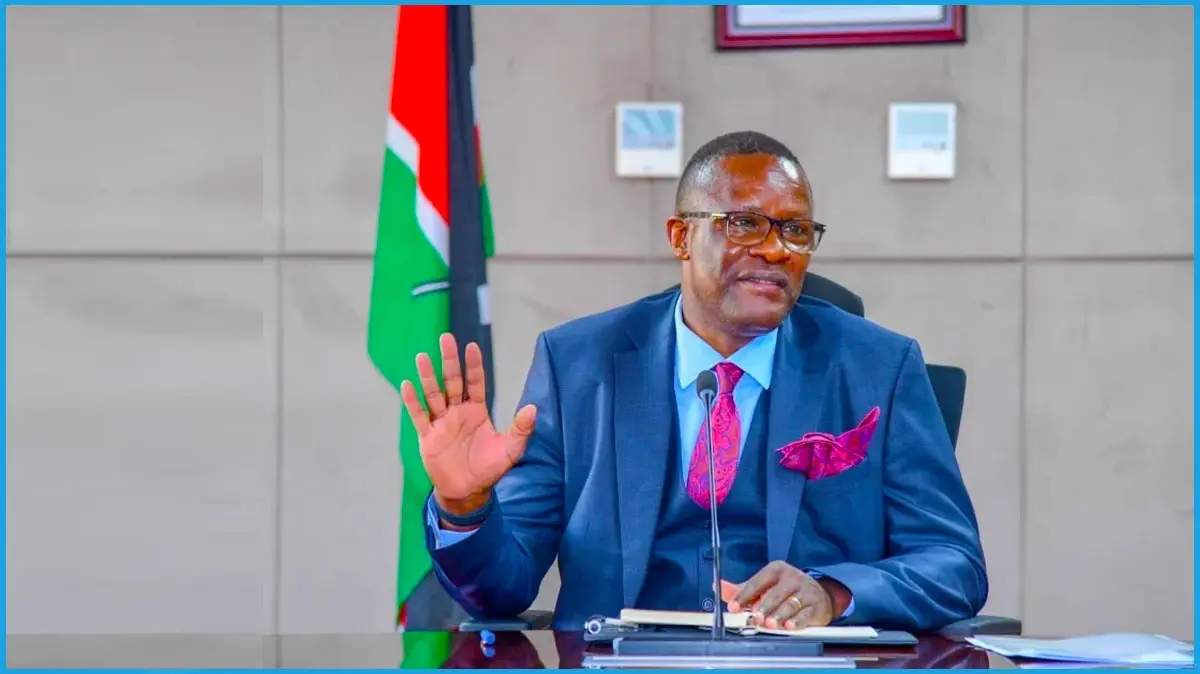
By the time Eliud Owalo stepped out of the gates of State House in January 2026, he had already declared his intention to run for president in 2027. Around the same period, he repeatedly placed his net worth in the billionaire range, a claim that quickly turned his finances into one of the most closely watched political wealth stories in Kenya this year.
The Billionaire Announcement
On Sunday, February 1, 2026, Owalo appeared on Citizen TV's Jeff Koinange Live and made a straightforward declaration about his personal finances. "I am worth about 1 billion shillings right now," he told the host. The statement came just days after he had publicly resigned from his role as Deputy Chief of Staff in charge of Delivery and Government Efficiency in President William Ruto's administration, following his announcement of a 2027 presidential bid.
The disclosure was deliberately timed. Having spent over 15 years working behind the scenes for prominent Kenyan leaders including Raila Odinga, Musalia Mudavadi, and most recently William Ruto, Owalo was now staking a claim on his own. Projecting financial independence from the outset appeared to be a calculated part of his political repositioning.
From KSh 645 Million to a Billion: The Three-Year Journey
To appreciate the significance of the KSh 1 billion figure, it helps to look back at where Owalo stood just a few years ago. In October 2022, when he appeared before the National Assembly's Committee on Appointments for vetting as Cabinet Secretary for Information, Communication, and Digital Economy, he declared his net worth at KSh 645 million.
At that vetting, Owalo was unusually detailed in breaking down his assets:
- Nairobi residence: KSh 120 million
- Upcountry residential house: KSh 70 million
- Upcountry land: KSh 200 million
- Four vehicles: KSh 15 million
- Hotel facility (incomplete at the time): KSh 80 million, with a projected completion value of KSh 293 million
- Commercial tree farming: KSh 160 million
By February 2026 — a span of roughly 39 months — his declared net worth had climbed to approximately KSh 1 billion, representing an increase of KSh 355 million, or an average of about KSh 9.1 million per month, according to a financial analysis by Sauce.co.ke.
Owalo attributed his wealth to three main areas: real estate investment, hospitality ventures, and agriculture, particularly his commercial tree farming operations.
What's Behind the Growth?
While Owalo did not publish a fully audited breakdown of his 2026 assets during the television interview, contextual clues from his earlier declarations and public statements point to the likely drivers of his wealth expansion:
Real estate appreciation: His Nairobi home, upcountry property, and land holdings — collectively worth around KSh 390 million in 2022 — would have appreciated in value over three years, especially given Kenya's property market dynamics in urban and peri-urban areas.
Hotel completion: The hotel facility he declared at KSh 80 million in 2022 was unfinished at the time, with a projected completion value of KSh 293 million. Progress on that project alone could account for a substantial portion of the KSh 355 million increase.
Tree farming maturation: Commercial tree farming is a long-term investment that gains value as plantations mature. His KSh 160 million tree farming portfolio in 2022 would have grown meaningfully in the intervening years.
Political Reactions: Scrutiny and Support
The rapid wealth accumulation has not gone unnoticed. Senator Boni Khalwale was among the public figures who raised an eyebrow at the pace of growth, noting the jump from KSh 645 million to billionaire status during a period when Owalo was serving in government. Online commentary has similarly been split, with supporters citing legitimate business growth and investment returns, while critics questioned whether government proximity played a role in accelerating his fortunes.
Owalo has pushed back firmly on such insinuations, arguing that his private sector foundation — built over more than 23 years as a strategy consultant — predates and undergirds his wealth. He says he successfully steered the ICT ministry as one of the most corruption-free dockets in government, and that political interference and procurement bottlenecks, not personal enrichment, frustrated him enough to leave.
"There is always a divergence between what you want implemented and the actual situation in the working environment," he told People Daily. "Corruption and conflict of interest derail such dreams."
The Broader Political Picture
Owalo's resignation on January 11, 2026 — the same day he announced his presidential ambitions at the 106th commemoration of his grandfather Prophet Johanna Owalo, founder of Kenya's first African independent church, the Nomiya Church in Siaya County — was steeped in personal and symbolic significance.
The Nomiya Church, which claims approximately 1.5 million followers across East Africa, has endorsed his bid. Its chairman, Calleb Olali, told the Daily Nation: "We met with Owalo, who is also the church's patron, and agreed to back him for presidency. We have always been a silent constituency, but this time we will make our voices heard through our son."
Beyond the church, Owalo has been quietly building a political infrastructure. Reports indicate he has set up a private secretariat equipped with data and call centre capabilities to support his campaign ground game. He has also pledged to unveil a new political party — reportedly assembled through the acquisition and restructuring of existing parties rather than building from scratch — to serve as his presidential vehicle.
As of April 2026, Owalo has continued positioning himself as a reform-driven alternative to President Ruto, promising to investigate how public debt has been utilised and hold accountable anyone found to have misused borrowed funds. He has also put forward a development agenda for Nyanza, including upgrading Kisumu International Airport for cargo, completing the Lake Victoria Ring Road, reviving the sugar and cotton sectors, and establishing processing factories across the region.
What the Net Worth Disclosure Really Means
In Kenya, where the ethics vetting process compels senior public servants to declare their assets publicly, financial disclosures carry weight well beyond personal finance. They serve as a proxy for integrity, business acumen, and independence from political patronage — all qualities voters scrutinise, particularly in a presidential race.
For Owalo, declaring KSh 1 billion puts him in a financially comfortable bracket among the field of 2027 aspirants. It signals that he does not need to depend on financiers or political godfathers to mount a campaign — a point he has made explicitly, telling Chamgei FM that he pledges to "remain open and accountable" and is willing to "work with leaders who share his vision, but not alliances formed solely for electoral gain."
Whether the optics work in his favour or invite deeper scrutiny will depend on how effectively he controls the narrative. His wealth, his grandfather's legacy, his track record at the ICT ministry, and his years inside the political engine rooms of Kenya's biggest parties give him an unusually layered public profile.
Final Takeaway
As of 2026, Eliud Owalo's net worth of approximately KSh 1 billion places him among the richest people in Kenya and his political contenders heading into the 2027 general election. His journey from KSh 645 million in 2022 to the billionaire threshold in under four years reflects a mix of investment growth, asset appreciation, and strategic communication.
The wealth disclosure was not incidental — it was part of a carefully constructed opening move in a presidential campaign that will test whether a former insider, technocrat, and political strategist can persuade Kenyans he is the right person to lead from the front, not just advise from the shadows.