The wrong type of business plan wastes months of work. The right one gets you funded, focused, or both.
Many business people keep wondering if they need a business plan or not. It is time to setle that debate and what a better way that using facts through data.
According to research aggregated from over 11,000 companies and published in the Journal of Management Studies, businesses with written plans grow 30% faster than those without.
Entrepreneurs with a completed plan are 260% more likely to actually launch their business. And 69% of venture capitalists report they will not invest in a new enterprise without first reviewing a formal plan.
The more useful question in 2026 is not whether you need to write a plan. What we ought to be asking ourself, which kind of business plan do we need. When it comes to business plans, there are two distinct formats: the Traditional Business Plan and the Lean Business Plan.
They serve different purposes, different audiences, and different stages of a business. Choosing the wrong can actively work against you besides wasting your time.
A 40-page traditional plan handed to an early-stage investor who expected a concise pitch signals that you misunderstand your audience. A one-page lean plan submitted to a commercial bank seeking a KSh 5 million loan signals that you are not serious.
This article gives you a clear framework for making the right choice.
What is a Traditional Business Plan?
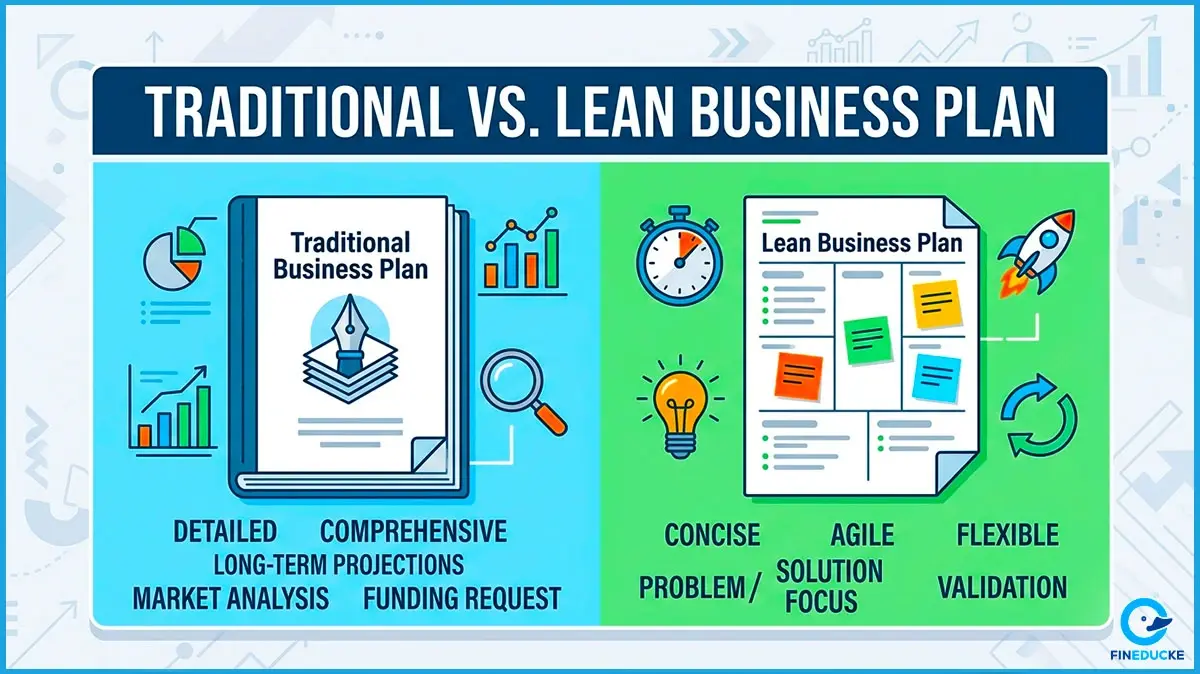
A traditional business plan is a comprehensive, structured document that covers every dimension of a business in detail. It typically runs between 20 and 40 pages, though complex ventures or those seeking large-scale financing can extend well beyond that.
It includes an executive summary, a full business description, a market analysis, competitive analysis, organizational structure, product or service descriptions, a marketing and sales plan, funding requirements, and detailed financial projections covering three to five years.
The financial section of a traditional plan is particularly rigorous. It includes a profit and loss projection, a cash flow statement, and a balance sheet forecast. These are the three documents that any serious lender or investor will examine before committing capital.
According to a 2024 survey of over 800 entrepreneurs by Upmetrics, businesses with formal plans secure 133% more investment capital than those without one, and 30% of businesses with formal plans successfully obtained loans, compared to just 12% of those without.
The traditional plan is built for permanence. It is designed to be a reference document, a pitch asset, and an accountability tool simultaneously. Its greatest strength is its depth especially when done well to ensure that it covers all aspects of the business/company.
Its greatest weakness is time. A thorough traditional plan typically takes four to eight weeks to complete properly. For a fast-moving startup still testing its assumptions, that timeline can be a liability rather than an asset.
What a Lean Business Plan Actually Is
A lean business plan distils the essentials of a business onto a single page or at most two. It draws from the Business Model Canvas framework developed by Alexander Osterwalder and the Lean Startup methodology popularised by Eric Ries, both of which prioritise speed, iteration, and customer validation over exhaustive upfront planning.
A lean plan typically covers four elements: the strategy (what you are doing and why), the tactics (how you will execute it), the business model (how you will make money), and the milestones and metrics you will use to measure progress.
It replaces lengthy prose with concise bullet points, replaces five-year projections with near-term financial targets, and replaces fixed assumptions with a living document designed to be updated as the business learns.
The core philosophy behind a lean plan is that your first assumptions about a market are almost certainly wrong. Rather than spend months building a perfect plan around unvalidated assumptions, a lean approach encourages you to test, measure, and adjust quickly.
Research from CB Insights' 2024 analysis of 483 startup post-mortems found that 42% of startups fail because they build products that nobody wants. This is a problem that lean planning, with its emphasis on early customer feedback, is specifically designed to prevent.
A lean plan is not a shortcut or a draft of a real plan. It is a fundamentally different planning philosophy suited to a different set of circumstances.
The Decision Framework: Five Questions That Determine Which Business Plan You Need
Rather than a simple checklist, the choice between traditional and lean comes down to five questions. Answer them honestly and you will have your answer on which plan is best for you.
1. Who is going to read this plan?
If you want to secure financing for your business, first decide on the targeted audience. When the primary audience is external, for instance, a bank, a commercial lender, an angel investor, a grant committee, or a formal accelerator, then a traditional plan is almost always required.
According to Upmetrics' 2026 business plan statistics report, approximately 70% of venture capitalists consider a written, structured business plan crucial for investment decisions.
Even investors who ultimately rely on a pitch deck for the initial conversation will conduct detailed due diligence using a full plan before signing a term sheet.
If the primary audience is internal; you, your co-founder, your early team, then the lean plan is the right fit. It keeps everyone aligned on strategy without creating a document so detailed it becomes outdated the moment reality intervenes.
2. What stage is the business at?
A business still testing whether its core idea has market demand should use a lean plan. The lean approach is explicitly built for the validation phase. The reason behind this is that it creates a lightweight framework for running experiments and updating assumptions without the sunk cost of a fully built-out traditional document.
A business that has validated its model, has early revenue, and is preparing for its next funding round or significant operational expansion should use a traditional plan.
The median Series A company in 2025 required $2.5 million in annual recurring revenue before investors would engage seriously, 75% higher than just four years earlier, according to research from GoElastic. At that stage, depth is expected.
3. How fast is the business environment changing?
In highly volatile or emerging industries, AI-native products, fintech, climate tech, markets shift faster than a traditional plan can keep pace. In these environments, a lean plan that can be updated monthly is more strategically useful than a traditional plan that is accurate on day one and obsolete by month three.
In more stable industries such as professional services, manufacturing, retail and logistics, the assumptions in a traditional plan hold for longer and the document retains its value over a meaningful planning horizon.
4. Do you need the document to hold you accountable?
If discipline is the primary goal then keeping yourself and your team focused on targets and milestones, a lean plan, updated regularly, is a better accountability tool than a traditional plan reviewed annually.
Research from the U.S. Bureau of Labor Statistics' 2024 data shows that 79.6% of businesses survive their first year, but only 50.6% make it to five years.
The businesses that survive tend to be those that review and adapt their strategy consistently rather than treating their plan as a one-time exercise.
5. Are you seeking a loan or equity investment?
This is often the clearest differentiator. Commercial banks and SACCOs in Kenya, as well as lenders through formal government schemes like the Youth Enterprise Development Fund, require detailed financial documentation before approving any loan.
A lean plan will not be sufficient. Equity investors and venture capitalists, particularly at the early seed stage, are increasingly comfortable with lean documentation paired with a strong pitch deck. However, they also expect a full plan to be available upon request during due diligence.
The Hybrid Approach: What Most Established Businesses Actually Do
The traditional vs. lean framing can create a false binary. In practice, most experienced founders use a layered approach: a lean plan as a living internal strategy document, and a traditional plan built from that foundation when an external audience requires it.
This sequence matters. Start with lean since it forces you to get clear on your value proposition, your customer, your revenue model, and your key milestones without getting lost in formatting and prose.
Once those fundamentals are validated by real customer behaviour and early revenue, the traditional plan almost writes itself because you are no longer guessing but just documenting what you already know to be true.
According to a 2025 report from LivePlan, the best investor-ready business plan for early-stage companies is a lean plan expanded with a rigorous financial model and a strong executive summary.
The document does not need to be 40 pages. It needs to contain everything an investor would need to make an informed decision.
A Simple Reference Guide
Situation | Recommended Plan |
Seeking a bank loan or SACCO financing | Traditional |
Pitching to angel investors or VCs | Traditional (with lean executive summary) |
Early-stage startup validating an idea | Lean |
Internal planning and team alignment | Lean |
Applying for a government grant or accelerator | Traditional |
Pivoting an existing business model | Lean first, then Traditional |
Established business planning next growth phase | Traditional |
Testing a new product line within existing business | Lean |
The Bottom Line
The debate over whether to write a business plan is over. The data is unambiguous. Businesses that plan grow faster, survive longer, and raise more capital.
The more relevant decision in 2026 is which format to use, and that decision should be driven by your audience, your stage, and your purpose.
A lean plan is not a lesser version of a traditional plan. It is a different tool for a different job. Knowing when to use each one is a mark of strategic clarity that investors and lenders will notice before you even begin to pitch.
If you are starting from scratch and need a step-by-step walkthrough, read our guide: How To Create Your First Simple Business Plan. If you want to understand which sections of your plan matter most to investors, read The Most Important Parts of a Business Plan.