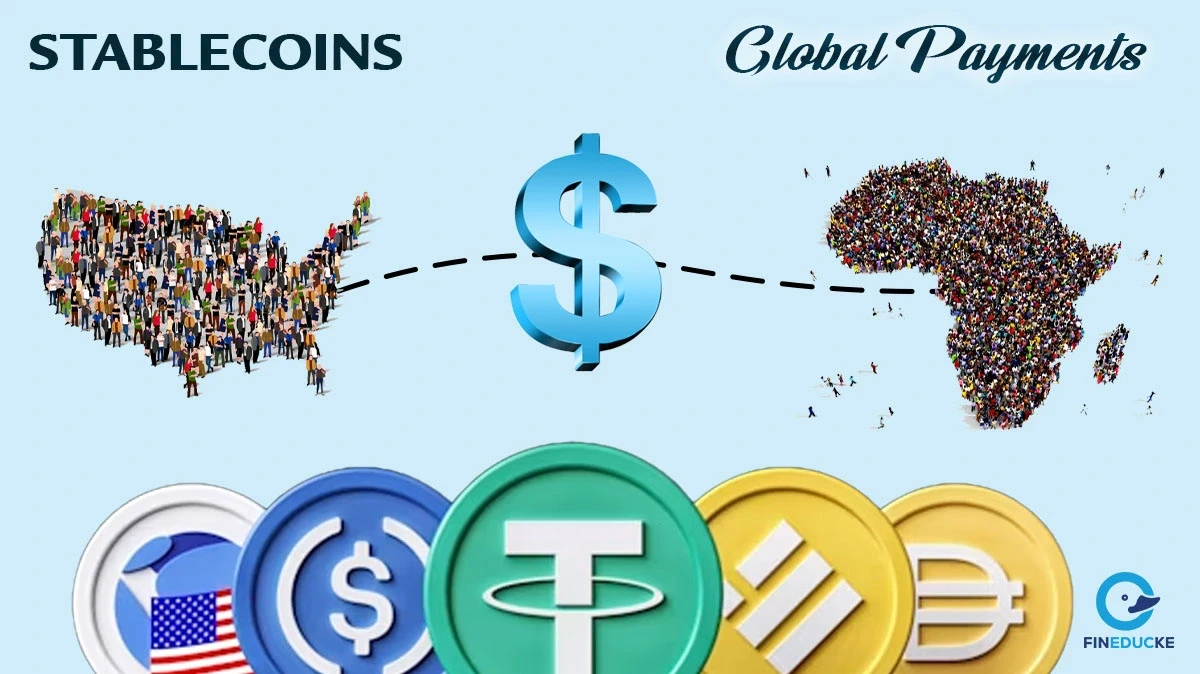
Imagine this. You’re working abroad, let’s say in the United States, and you’re trying to send $200 to your family back home in Ghana or Kenya. You walk into a bank, fill out forms. Then you wait in line and by the time the money finally arrives three days later, $50 has vanished into fees and hidden charges.
Now let’s envision a different reality. You send the same $200 as digital dollars on a blockchain, and within minutes, your family gets the full amount on their phone. No banks, no middlemen, no inflated fees. Just money moving as easily as an email.
That’s the promise stablecoins bring in 2025. Unlike Bitcoin or Ethereum, whose prices can swing wildly in a day, stablecoins are designed to hold steady and they are usually pegged to the US dollar. What makes them cheaper and their transactions faster compared to traditional systems is because they’re built on crypto rails.
In this article, we’ll unpack what stablecoins are, why they matter for global payments, the risks you need to know, and examine whether they really are the future of money.
What Exactly Are Stablecoins?
At their core, stablecoins are cryptocurrencies designed to behave like regular money. Instead of swinging up and down like Bitcoin or Ethereum, their value is tied to something stable, usually the US dollar. One stablecoin is built to equal one dollar, no matter how crazy the crypto market gets.
There are three main types of stablecoins; fiat backed, crypto backed and algorithimic stablecoins.
- Fiat-backed stablecoins: These are the most common. Companies like Tether (USDT) and Circle (USDC) hold real-world dollars or dollar-denominated assets in reserve. In theory, for every token they issue, there’s a dollar in a bank somewhere. That’s why people tend to trust them more.
- Crypto-backed stablecoins: Instead of holding dollars in a bank, these use other cryptocurrencies as collateral. The most famous stable coin under this category is DAI. It is backed by assets like Ethereum. To keep things balanced, you usually have to over-collateralize, this means locking in more value than the coins you borrow.
- Algorithmic stablecoins: Algorithmic stablecoins rely on smart contracts and supply-demand tweaks to stay stable.They sound clever on paper, but history hasn’t been kind. The collapse of TerraUSD (UST) in 2022 wiped out billions and proved just how fragile purely algorithmic models can be.
Stablecoins matter because they act as a bridge between traditional money and the crypto world. Take the example of USDT: its peg to the dollar gives traders and everyday users confidence that $1 in Tether will always equal $1 in their pocket or wallet. For a deeper look at how coins like USDT maintain their $1 peg, platforms like https://cryptomonitor.info/ provide live market data and insights that you can use to better understand.
The Problem Stablecoins Solve
The global financial system may feel advanced, especially with the advancement in technology. However, when it comes to transferring money across borders, it’s still very slow and expensive.
Imagine someone sending money from the US to a relative in the Philippines. A traditional bank wire can take days, and by the time the funds arrive, $20 to $50 has already been consumed in fees and hidden charges. This is very painful especially for someone sending $200 or less.
This isn’t a small problem. According to World Bank data, in Q4 2023 the global average cost of sending USD 200 was about 6.4 percent, meaning billions are lost each year to fees, hidden charges, and intermediaries.
And remember, it’s not just families sending money home. Freelancers working with international clients also engage in money transfer, small businesses buying goods abroad need to move money, even charities trying to move aid run into the same roadblocks.
Now, this is where stablecoins come in. Instead of waiting days, transactions can now clear in seconds, and instead of paying 6%, the fee can cost pennies or even less. For example, sending USDT from the US to India or Maldives costs almost nothing and arrives instantly, and the better part you don’t need to fill paperwork, worry about bank holidays, no hidden conversion charges.
For millions of people, especially in regions where financial access is limited, stablecoins don’t just save money. They unlock opportunities. A freelancer in Istanbul or Rio de Janeiro can be paid in stablecoins today and spend them within minutes, without losing a chunk of their income to fees.
Benefits of Stablecoins in 2025
The first big win with stablecoins is speed. Compared to banks or money transfer apps, stablecoins usually clear in seconds. That’s a game-changer for businesses, freelancers, and families who can’t afford to wait.
Then there’s the cost. Instead of losing 5–10% of your transfer to middlemen, stablecoins often cost pennies per transaction. Whether you’re moving $20 or $20,000, the fees barely change, making them far more efficient than traditional remittance systems.
Accessibility is another big win. Anyone with a smartphone and internet connection can send, receive, or store stablecoins. For the 1.4 billion adults who don’t have bank accounts but do have a phone, that’s a lifeline. For them, stablecoins provide a way to participate in the global economy without needing a bank account. Tools like CryptoMonitor make it easier for users to track different stablecoins and decide which ones are most trusted in the market.
Stablecoins also act as a hedge against inflation in countries where national currencies are collapsing. Take the case of Venezuela, where years of hyperinflation have eroded trust in the bolivar. Now lets consider a shopkeeper there, If he or she keeps her earnings in bolivars, their value drops almost overnight. However, if the same shopkeeper holds USDT, her savings remain tied to the dollar, protecting her from losing purchasing power.
And beyond payments, stablecoins plug directly into the world of DeFi (Decentralized Finance). Users can lend them out to earn yield, use them as collateral to borrow other assets, or trade them instantly without needing a bank. For everyday users, this means more ways to grow wealth, even without traditional financial institutions.
Risks & Challenges Stablecoins in 2025
Like anything promising, stablecoins come with downsides too. Governments around the world remain skeptical. This is so particularly when it comes to Tether (USDT) which the largest stablecoin by market cap. Regulators worry about transparency, reserves, and the possibility of these coins undermining national currencies. As rules tighten, some coins may face restrictions, and users could see changes in how they’re traded or used.
Another concern is centralization. While stablecoins feel like “crypto money,” most of the biggest ones, like USDT and USDC are controlled by private companies. This means a small group of executives has the power to freeze funds, blacklist addresses, or decide who can and can’t use the coin. For those who turn to crypto seeking freedom from traditional gatekeepers, this centralized control raises serious questions.
Then there’s the risk of depegging. Algorithmic stablecoins were designed to stay stable without reserves, relying only on code and market mechanics. In theory, they worked. In practice, the collapse of TerraUSD (UST) and its sister coin Luna in 2022 wiped out over $40 billion in value. This scenario showed how fragile these models can be when confidence breaks.
Even the safest stablecoins carry technical risks. If you lose your private keys, your money is gone for good. Hacks, phishing scams, or simple mistakes like sending funds to the wrong wallet address can also lead to irreversible losses. Unlike banks, there’s usually no customer support line to call. Such risks makes many people hesitant in adopting their use.
So while stablecoins offer speed and accessibility, they are not a magic bullet. Anyone using them needs to understand the trade-offs, take security seriously, and keep a cautious eye on regulation. The promise is real, but so are the risks.
Stablecoins vs. CBDCs
As stablecoins grow in popularity, governments have been working on their own version of digital money: Central Bank Digital Currencies (CBDCs). Unlike stablecoins, which are issued by private companies, CBDCs are created and controlled directly by central banks in different countries. Think of them as a digital form of national currency in your country.
The key difference lies in control and trust. With CBDCs, governments have full oversight. They can monitor transactions, enforce monetary policy, and ensure stability. For policymakers, that level of control is a feature, not a bug. But for everyday users, it also raises concerns about privacy and surveillance.
Stablecoins, on the other hand, offer more flexibility. They operate on open blockchain networks meaning they experience faster innovation, easier integration with DeFi and borderless usability. People trust them not because a central bank says so, but because they’re useful in real-world transactions.
It’s not necessarily a competition, though. There’s a strong chance CBDCs and stablecoins will coexist. CBDCs may become the “official” digital money for domestic transactions, while stablecoins remain the go-to option for global payments, remittances, and decentralized finance.
In short, CBDCs give governments control, while stablecoins give users freedom. The future of money may involve both, each serving different roles in the digital economy.
The Future of Stablecoins
Stablecoins are moving from niche crypto circles into the mainstream financial system. Businesses, payment companies, and even traditional banks are starting to experiment with them as a feasible tool for payments and settlements. What once felt like a crypto shortcut is now being tested as a backbone for global money movement.
Big players are already making moves. In 2023, PayPal launched its own stablecoin, PYUSD, pegged to the US dollar, signaling that fintech giants see this as more than a trend. Visa and Mastercard have also begun testing stablecoin-powered payments with the goal of allowing merchants to accept crypto without worrying about volatility. These aren’t small pilots but rather global networks quietly laying the rails for a new kind of money.
The numbers tell the same story. In 2022, stablecoins settled over $7.4 trillion in transactions on public blockchains. Meanwhile, major credit card networks like Visa, Mastercard, UnionPay, American Express, and Discover together processed more than $40 trillion in global purchase volume for cards, debit, and prepaid payments.
In recent data, some reports show stablecoins processed nearly $14 trillion in 2024, overtaking Visa’s $13 trillion in transaction volume. In broader analyses, stablecoin transfers totaled $27.6 trillion throughout 2024 thus surpassing the combined volumes of Visa and Mastercard.
As adoption spreads, stablecoins may become as common as debit cards. The future isn’t about replacing cash overnight, it’s about weaving stablecoins into everyday life involving cross-border payments and online shopping. The shift has already begun and we are here to witness.
Practical Guide: How to Use Stablecoins Today
As a beginner, getting started with stablecoins isn’t as complicated as it sounds. The first step is buying them, which you can do on most major crypto exchanges like Binance, Coinbase, or Kraken among many others. Many of these platforms let you purchase stablecoins directly with a debit card, bank transfer, or even peer-to-peer (P2P) trades.
Once you’ve bought stablecoins, you’ll need a wallet to store them. There are two main types:
- Hot wallets are apps or web-based wallets connected to the internet. They’re convenient for everyday use, like sending money or shopping online.
- Cold wallets are hardware devices or paper wallets kept offline. They’re less convenient but far safer for long-term storage since hackers can’t access them remotely.
When it comes to safety, a few best practices go a long way: never share your private keys, enable two-factor authentication, and double-check wallet addresses before sending funds. Unlike a bank, there’s no “forgot password” button in crypto, so personal responsibility is key.
So how can you actually use stablecoins? The possibilities are growing every day. You can send remittances across borders in seconds, shop online with merchants that accept crypto, or simply hold them as savings if your local currency is unstable. Some even put their stablecoins to work in DeFi platforms to earn passive income.
Stablecoins may feel like a niche tool now, but in practice, they’re already making money faster, cheaper, and more accessible.
Conclusion
Stablecoins have quietly become one of the most practical bridges between the digital world of cryptocurrency and the realities of everyday money. From sending remittances to protecting savings in inflation-hit economies, they solve real problems that millions of people face daily.
But like any financial tool, they come with risks. Centralization, regulation, and technical pitfalls mean users need to approach them with caution. The promise of instant, low-cost, borderless money is powerful but it’s only as strong as the choices you make in how you use and store it.
The future of money is still being written, and stablecoins are at the center of that story. Whether they evolve alongside government-backed digital currencies or carve out their own path, they’ve already shown they’re more than a passing trend.
If you’re curious about where this is headed, the best step is to keep learning, stay cautious, and use reliable resources. Tools like https://cryptomonitor.info/ can help you track stablecoin markets, adoption trends, and the shifting landscape of digital finance. The opportunity is already here, the real question is, how will you use it?